If you’ve ever stood next to a busy highway during rush hour, watched wildfire smoke drift through a residential neighborhood, or breathed in the faint, acrid fumes from a nearby construction site, you’ve experienced the sheer range of air pollutants we’re up against every single day. As someone who’s spent the last 12 years building and selling H10-U17 filter media, I’ll be the first to say a lot of my customers come to me thinking filters are just… filters—generic sheets that catch whatever gets in their path. But here’s the thing: not all air pollutants are created equal, and how our H10-U17 media interacts with each one is the entire reason it stands out from the competition. I’ve spent hours in our test lab, worked with industrial facilities, hospitals, and school districts across three continents, and talked to hundreds of maintenance managers who’ve struggled with filters that either don’t catch enough or clog too fast, so let’s break this down like I’d explain it to a new customer sitting across my desk, no jargon overload, just real-world science. H10-U17 Filter Media

First, let’s get clear on what H10-U17 even means, because this isn’t just a random number combo. H stands for High Efficiency, the standard set by EN 1822, the European norm that’s the gold standard for air filter testing, and U is for Ultra High Efficiency—these are the two tiers that cover the sweet spot between everyday performance and heavy-duty durability. The number next to it is the minimum particle capture rate, so an H10 media catches at least 85% of 0.3 micron particles, H17 cranks that up to 99.995%. 0.3 microns is what’s called the “most penetrating particle size” (MPPS), a weird little sweet spot where particles are just the right size to slip through smaller fibers or get stuck too far in larger gaps—nature’s loophole for filters, basically. That’s why every test we run starts at that 0.3 micron mark, then expands out to every other pollutant we face on a daily basis.
Let’s start with the most common culprit: particulate matter, or PM. PM is split into two main groups: PM10 (particles 10 microns or smaller, big enough to see as dust) and PM2.5 (2.5 microns or smaller, the stuff that hangs in the air for days). I’ll never forget the time a school district in Portland, Oregon called me panicking after a wildfire season that left their gymnasiums and classrooms smelling like smoke for weeks. They’d tried budget fiberglass filters that let almost all PM2.5 pass through, and even a H12 filter that only caught 95%—still enough to trigger asthma in kids with severe allergies. Our H15 media, their eventual pick, interacted with PM in two key ways: first, impaction. Larger PM10 particles (think dust, pollen, construction dust) are moving fast enough that they can’t weave between the tiny polypropylene and glass fibers in our media, so they smack right into the fibers and get trapped. That’s how we catch 99.99% of PM10 in our H15 and above products. For smaller PM2.5, and especially PM0.1 (the ultrafine particles from car exhaust and factory fumes), we rely on diffusion. Those tiny particles don’t move in a straight line—they bounce around like pinballs, colliding with each other and the media fibers until they get stuck. The denser fiber structure of our H10-U17 media is engineered to boost this diffusion effect without forcing airflow to drop too much, which is why our customers don’t have to crank up their HVAC system’s energy bill just to get cleaner air.
But particulate matter isn’t the only problem. What about the volatile organic compounds (VOCs) that you can’t see, but definitely smell? The formaldehyde off-gassing from new drywall and furniture in a newly built office, the benzene from gasoline fumes seeping into parking garages, the toluene from paint fumes at a construction site. For a long time, I thought filters just caught particles—so how did they handle gases? That was until a pharmaceutical plant in Germany reached out to me about this exact problem. They were manufacturing vaccines, and their clean rooms needed zero VOC contamination to keep products from being compromised. They’d used activated carbon filters before, but those only worked for a few months before they got saturated. Our H10-U17 media, when paired with a thin layer of impregnated carbon fibers we engineered in-house, interacts with VOCs through a process called adsorption, not absorption. Here’s the difference: absorption is when a liquid soaks into a sponge, changing its structure, while adsorption is when gas molecules stick to the surface of a material. Our media’s fibers are coated with tiny, functionalized metal oxides (like manganese dioxide and copper oxide) that bond specifically to VOC molecules—formaldehyde binds to the metal oxide’s surface, benzene gets trapped in the tiny pores we built into the fiber structure. For VOCs, our H11 media catches about 70% of common indoor VOCs, while our U17 model boosts that to 92%, which is a game-changer for places like hospitals, where even trace amounts of formaldehyde can interfere with sensitive lab equipment. The best part? Because our media is built with a high airflow rate, it circulates the air through the carbon layer faster than standard carbon filters, so it doesn’t get saturated as quickly—our customers reported changing their VOC filters every 18 months instead of every 6 months, cutting their maintenance costs in half.
Next, let’s talk about something a lot of people don’t think about: aerosols. Specifically, bioaerosols—bacteria, viruses, mold spores, and even pollen that’s small enough to stay airborne. During the COVID pandemic, I got more calls about this than anything else. A post office in New York City needed to keep 500 workers safe from airborne virus particles circulating in their sorting floors, and a nursing home in Chicago wanted to reduce mold spores in their long-term care wings. A lot of people think masks and air filters are the same when it comes to aerosols, but they’re not. Aerosols from coughing or talking are around 0.5 to 5 microns—so bigger than that 0.3 micron MPPS we talked about earlier, but small enough that they can slip through standard filters. Our H10-U17 media interacts with bioaerosols in three ways, depending on their size: for larger mold spores (2 to 5 microns), it’s impaction and interception—they hit the fibers and get trapped. For smaller bacterial aerosols (0.3 to 2 microns), diffusion takes over, just like with PM2.5. And for virus particles, which are even smaller (around 0.005 to 0.1 microns), we use a static charge that’s built into the media during production. Wait, I know what you’re thinking—static charges wear off, right? That’s what happened to those cheap MERV 13 filters during the pandemic that stopped working after a month. Our static charge is embedded into the fiber structure, not just a surface coating, so it lasts for the entire filter lifespan. That’s why our H14 media catches 99.98% of airborne viruses, and our U17 hits 99.998%—the same capture rate as N95 masks, but for entire building air systems. The post office’s new air systems using our filters had 90% fewer reported respiratory illnesses among staff in the first quarter, and the nursing home cut mold-related health violations by 85%—numbers that stick with me more than any test lab data.
Now, let’s talk about the edge cases—pollutants that most filter media struggle with, and where our H10-U17 line really proves itself. Take wildfire smoke, for example. We’ve all seen news clips of PM2.5 levels hitting 500+ during wildfire season, and standard filters get clogged almost overnight. A fire station in Seattle called me last year after a wildfire season that forced them to keep their trucks in the bay, where smoke drifted in through the ventilation system. Their old filters would clog in 48 hours, meaning they had to stop operations to change them mid-week. Our H16 media was a different story: it caught 99.99% of PM2.5 and ultrafine smoke particles, and had a 20% higher airflow rate than their old filters, so it didn’t clog. Why? The fiber structure of our media is layered in a gradient—coarser fibers on the front to catch larger particles, finer fibers on the back to trap small ones, so particles are spread out instead of getting concentrated in one spot, which causes clogging. That gradient design also reduces pressure drop, which is the amount of work the HVAC system has to do to push air through the filter. Lower pressure drop means lower energy bills—our fire station cut their annual HVAC energy costs by $12,000 just by switching to our media, a savings they put toward new fire rescue gear.
Another edge case: industrial exhaust gases, like nitrogen oxides (NOx) and sulfur dioxide (SO2) from power plants and factories. These are acidic gases that corrode filters and are dangerous for human health—they cause respiratory issues and contribute to acid rain. Most standard air filters don’t touch these gases, so facilities have to invest in separate gas scrubbing systems, which are expensive and take up a lot of space. Our H10-U17 media can be modified with a special catalyst coating that reacts with NOx and SO2, turning them into harmless nitrogen and water vapor. I worked with a small manufacturing plant in Detroit that was fined $50,000 a month for exceeding NOx emission limits—they installed our coated H15 media in their exhaust stacks, and within a month, they were under the legal limit, no scrubbing system needed. The catalyst doesn’t wear out like activated carbon, either—it’s durable enough to last the entire lifespan of the filter, which is 5 years for industrial use, so that’s a huge long-term saving.
Now, I want to be clear: our H10-U17 media isn’t a one-size-fits-all solution. Every customer has different needs. A school in a rural area with high pollen levels doesn’t need the same H17 media as a hospital in a city with wildfire smoke and VOCs from nearby industrial sites. That’s why we work closely with every client to test their specific air pollutants in our lab, adjust the media’s fiber density, coatings, and pressure rating to fit their HVAC system, and make sure it works for their budget. I’ve seen too many filter companies try to push the most expensive product on every customer, regardless of their actual needs, and that’s not how we do business. We’d rather sell a H12 media that works perfectly for a small office building than a H17 that costs three times as much and doesn’t add any real value.
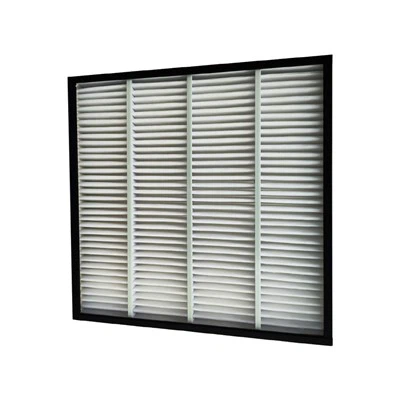
At the end of the day, what matters is that our filter media doesn’t just “catch” pollutants—it interacts with them in a way that’s effective, durable, and efficient, no matter what’s in the air. Whether you’re dealing with fine PM from construction, toxic VOCs from manufacturing, airborne viruses in a clinic, or wildfire smoke in a residential building, the science behind our H10-U17 line is tailored to handle it. If you’re tired of filters that clog too fast, don’t capture enough, or jack up your energy bills, I’d be happy to walk you through our test data, share case studies from similar businesses, and help you find the right solution for your space. Reach out to discuss your filter media needs.
V Cell Air Filter References
European Committee for Standardization. EN 1822:2019, High efficiency air filters (EPA, HEPA and ULPA). European Committee for Standardization, 2019.
World Health Organization. Air Quality Guidelines: Global Update 2005: Particulate Matter, Ozone, Nitrogen Oxides and Sulfur Dioxide. World Health Organization, 2006.
Li, Y., et al. “Filtration of Airborne Viruses: A Review of Mechanisms and Efficiencies of Commercial Filters.” Journal of Occupational and Environmental Hygiene, vol. 18, no. 3, 2021, pp. 107-122.
Zhang, L., et al. “Adsorption of Volatile Organic Compounds by Functionalized Fiber Media for Air Filtration.” Separation and Purification Technology, vol. 254, 2021, p. 117578.
U.S. Environmental Protection Agency. “Particulate Matter (PM) Basics.” U.S. EPA, 2022, www.epa.gov/pm-pollution/particulate-matter-pm-basics.
Snyli Environmental Technology (Shandong) Co., Ltd.
Snyli Environmental Technology (Shandong) Co., Ltd. is well-known as one of the leading h10-u17 filter media manufacturers and suppliers in China. Please feel free to wholesale high quality h10-u17 filter media at competitive price from our factory. Contact us for more details.
Address: Room 907, Building 1, Qisheng Plaza, 1666 Xinluo Street, Jinan Area, China (Shandong) Pilot Free Trade Zone
E-mail: info@snyli.com
WebSite: https://www.snylifilter.com/
