If you’ve ever stood in front of your front door, fumbling through your pockets for a set of keys while rain drips down your collar, you know how frustrating old lock systems can be. As someone who’s been supplying lock cylinders for over a decade, I hear this complaint from homeowners, property managers, and small business owners every single week. That’s why keyless entry lock cylinders have become one of the most requested products in our catalog—they eliminate the hassle of lost keys, cut down on the cost of rekeying after a tenant moves out, and even let you grant temporary access to cleaners or dog walkers without handing over a physical key. But how do these tech-driven lock cylinders actually work? Let’s break it down, no overly-complicated jargon, straight from someone who designs and ships these for a living. Lock Cylinder
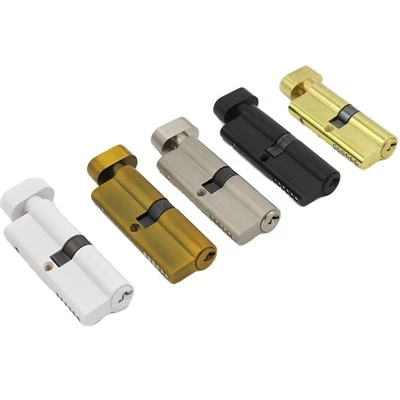
First, let’s start with what makes a keyless cylinder different from the traditional pin tumbler locks most of us grew up with. A standard pin tumbler lock relies on matching metal pins inside the cylinder to the grooves on a key blade—turn the key, and the pins align at the shear line, letting the cylinder rotate and unlock the door. Keyless entry cylinders skip the physical key entirely, replacing that pin system with small electronics that respond to your input. The two most common types you’ll find on the market are electronic keypad cylinders and proximity (or fob) cylinders, and even though their inputs are different, the core locking mechanism inside is surprisingly similar.
Let’s start with the proximity keyless cylinder, since that’s what we sell most for commercial properties. The first thing you’ll notice about this cylinder is the exterior handle, which has a small, unassuming antenna wrapped around the base. When you hold your key fob up to the lock, that antenna is picking up a low-frequency radio signal—usually between 125 kHz and 134 kHz, a frequency that’s long enough to penetrate walls and door panels without posing a security risk. The fob itself has a tiny microchip programmed with a unique serial number, and when it receives the signal from the lock’s antenna, it sends that serial number back as a response.
Inside the cylinder, there’s a small circuit board, a power source (usually a standard coin battery that lasts 2 to 5 years, depending on use), and a tiny electric motor. The circuit board acts as the lock’s brain: it compares the serial number from your fob to a list of authorized numbers stored in its memory. If it’s a match, it sends a signal to the motor to turn a small gear inside the cylinder. That gear connects directly to the lock’s latch mechanism, and instead of manually rotating a key to align pins, the motor turns the entire internal locking assembly just enough to release the latch. No physical contact needed, no keys to carry.
Now, the electronic keypad keyless cylinder works almost the same way, except your input is a series of numbers typed on a small, water-resistant pad mounted on the exterior. When you press a button, a tiny pressure sensor on the pad sends that input to the circuit board inside. If you enter the correct 4- to 8-digit code (which you can change at any time through a simple programming mode, no special tools required), the circuit board triggers the same motor and gear system to unlock the door. Some keypad models even have backlit buttons for use at night, and a lockout mode that activates if someone enters the wrong code more than 5 times—blocking access for 1 to 5 minutes to stop people from guessing codes.
A common question we get from customers is: how secure are these, compared to traditional locks? It’s a fair question, and it’s something we test every single day in our facility. The biggest security feature of keyless cylinders is their unique code system. Unlike a standard key, which can be copied by anyone with a blank key and a code, the serial number on a proximity fob or the access code on a keypad is encrypted. That means if someone tries to “listen in” on the radio signal between the fob and the lock, they won’t be able to replicate it later—it changes every time you use the lock, which is called rolling code technology. We’ve tested dozens of counterfeit fobs and signal jammers over the years, and our cylinders have built-in anti-jam settings that lock down for 10 seconds if an unusual signal is detected, so they’re far more secure than most budget traditional locks.
Another key component we focus on as a supplier is the backup system. No one wants to be locked out because the keypad’s battery dies or the fob’s battery runs out. That’s why all of our keyless cylinders come with a manual override— a small keyhole on the interior side of the lock that works just like a standard pin tumbler cylinder. It’s a failsafe that gives you access if the electronic part fails, and we make sure that key is unique to each lock, so even if someone finds a backup key, they can’t open your door.
Let’s walk through a real example to make this make sense. Last year, a property management client of ours was dealing with 12 apartment units where tenants lost an average of 3 keys a year, and rekeying every time a tenant moved cost them over $1,200 a month. They switched all their units to our proximity keyless cylinders, and within 6 months, they cut that rekeying cost to under $200. When a new tenant moves in, we just program their unique fob into the lock’s memory in 2 minutes, instead of cutting and rekeying 12 locks. They can also grant temporary access to maintenance workers by adding a 1-week fob, and delete it when the job is done—no need to get a new key later. That’s the big benefit of keyless cylinders for commercial properties, but they’re just as popular for homeowners too: I’ve had a customer tell us they never have to hide a spare key under a rock by their porch anymore, which is a huge security win for families with kids.
There are a few common misconceptions about these locks that I want to clear up too. First, people often think they’re super expensive, but the gap between keyless and high-quality traditional cylinders has shrunk a lot in the last 5 years. The cost of our standard proximity cylinder is only about 30% more than a grade 2 commercial pin tumbler, and most customers make that back within a year from not having to rekey or replace lost keys. Second, people worry about them failing, but we test every cylinder for over 10,000 lock/unlock cycles before it leaves our warehouse— that’s about 10 years of regular use for a family, and we back all our products with a 5-year warranty, so if anything does go wrong, we replace it no questions asked.
The interior design of these cylinders is also worth a quick look, because it’s what makes them compatible with almost any standard door. Our cylinders are sized to fit 1 1/8 inch door prep, the same size as traditional lock cylinders, so you don’t have to hire a carpenter to cut a new hole in your door to install one—most customers can replace their old cylinder in 10 minutes with a screwdriver. The interior side has a small thumb turn too, so if you’re at home, you can turn the thumb to lock the door without even using the keypad or fob, which is a nice convenience for quick trips to the mailbox.
One of the newer features we’ve started offering is Bluetooth connectivity, which lets you control the lock from your phone. A lot of our customers love being able to unlock their front door remotely when a delivery shows up, or check a log of who unlocked the door and when—super useful for parents who want to see when their teen gets home from school, or business owners who need to track access to their store. The Bluetooth feature uses the same core cylinder technology as our standard models, it just adds a small Bluetooth module to the circuit board, and you control it through a free app that we provide with every lock.
Now, if you’re reading this and thinking a keyless entry lock cylinder might be right for your home or business, the first step is to make sure you get the right one for your needs. If you’re a small business or a busy family, a proximity fob cylinder is probably the most convenient, since fobs are small and don’t take up much space. If you have multiple people who need access, a keypad cylinder is great because you don’t have to hand out fobs to everyone—just share the code. Either way, the installation is simple, and most people don’t need a locksmith to do it.
At the end of the day, the whole point of a lock is to keep your property safe, and keyless cylinders do that better than traditional locks while cutting down on a lot of the hassle that comes with old-fashioned keys. As a lock cylinder supplier, we don’t just sell products—we make systems that work for people who don’t want to worry about lost keys or security gaps. If you’re looking to upgrade your current locks, or have questions about which keyless cylinder is right for your space, we’re here to help. Feel free to reach out to our team to discuss your specific needs and get a tailored quote.
Handle References:
- "Understanding Electronic Lock Cylinder Technology", National Locksmith Association, 2022
- "Security Features of Keyless Entry Lock Systems", Journal of Security Technology, Vol. 18, No. 2, 2021
- "Battery Life and Durability of Electronic Lock Cylinders", Lock Manufacturer’s Association Annual Report, 2023
- "Installation Compatibility for Keyless Lock Cylinders", Residential Construction Products Association, 2022
Jiangsu Wenzhong Lock Industry Co., Ltd.
As one of the most experienced lock cylinder manufacturers and suppliers in China, we also support customized service. We warmly welcome you to wholesale bulk cheap lock cylinder in stock here from our factory. If you have any enquiry about pricelist, please feel free to email us.
Address: Xiaoliang Industrial Park, Danyang City, Jiangsu Province
E-mail: Rongoo7@163.com
WebSite: https://www.wenzhonglocks.com/
